Saturday, September 5, 2015

What Did We Do at School Today?

Often, parents want to know what their child did at school everyday.

This is completely, 100% understandable, and it is their right to know. It is their baby who they are graciously sending off to school every morning. They have a lot of hopes and dreams for their child. They have a lot of wonderings and questions about their child. Will my child make friends? Will my child be kind? Will my child learn new things?

It is so difficult, however, to answer the question, "What did my child do at school today?" because, if I answer you honestly, this is what it would look like.

It wouldn't look like a seamless, followed-to-the-exact-minute schedule.

It wouldn't look like your child sitting at a desk all day long, doing long calculations, reading a textbook, working in a workbook, or doing lots of worksheets.

It wouldn't look like a perfectly silent and quiet classroom, with all 19 children obeying and following and listening to every direction.

It looks like this...

Today, I greeted each of your children at the door as they entered and got ready for their day. I want them to know that I see them, that I know they are there, and that their presence at school today is celebrated.

Today, I led your children in exercises of independence and organization. I taught them how to unpack their backpacks everyday, put their take-home folders in the right basket, get their iPad ready for the day, and get started on their morning work. You see, we are working on doing things by ourselves, instead of having others do them for us. We also practiced how to gather all of our needed materials for math class by ourselves, which starts right after announcements are over.

But, after announcements were over, I led your children in understanding the "why" behind saying the US and Texas pledges, as well as why we observe a moment of silence. Lots of them were still trying to sit down or continue to work during these things, or talking or making noises during the moment of silence to be funny. We discussed the importance of respecting our state, country, and fallen soldiers who have fought to protect our freedoms. We discussed the freedom of getting to go to school, to learn, to worship the way we want, to dress the way we do, to marry the person we want. We practiced doing the pledge and moment of silence after these discussions, and your children showed ample respect.

Today, we had math class. During math, we talked about what good mathematicians do. We learned the value in double checking our work. We learned how to organize our thinking about numbers and place value. We learned how to take our time to do a good job. We learned how to download an app and how to use it the right way. We used the app to show the place value of numbers up to 120 and beyond, because I let your children pick their own number and show me all that they could do. Then, we worked on your child's individual math goal that they had set at the beginning of the year. I pulled each child one at a time to work with them individually on their specific goal. I taught one-on-one lessons about multiplication, division, and triple digit subtraction with borrowing-- because those were your children's goals, and I'm not going to stop them from going beyond the curriculum if they can. While they weren't with me, they were doing challenging problem solving questions or logic puzzles in groups. When math was over, I could barely break them away from their focus. They were so into their learning.

Today, we had snack time, because your children get hungry mid morning and I want to listen to that. Their basic needs must be met before learning can happen, so I let them have a snack.

Today, our class circled up and I told them good morning by name and that I was glad they were here today. We talked about how we are feeling today, because sometimes children can carry in hurt or pain or confusion or anger to the classroom, and this is a time to check in and help them overcome those things.

We talked about who we become when we enter this classroom, and who we want to be. Among the answers from your children were: thinkers, dreamers, learners, writers, authors, scientists, friends, artists, readers, loved, and important. I never want them to forget the possibilities within.

We talked about our favorite parts of the week, and reflected as a group on the wonderful things we had done together in class. We laughed together, practiced listening skills and how to make eye contact with others, how to wait our turn when someone else is talking, how to respond to someone's story or thought, and how to show respect in a group and value everyone's voice.

Today, we did a brief but fun calendar time. I asked your children questions like "what number month of the year is the month of June/September/December" or "what would the code date be 6 days from today?" because I know that your children already know the months of the year or how to write today's code date, so I added some depth to it.

Today, we talked about character, how to start a chain reaction of kindness, and read the book "Each Kindness" together, which is about a little girl who lost her chance to show kindness to another child, and it was too late. We talked about being brave and showing courage by being kind. We made text-to-self connections to our own life as we read, and commented on how parts of the book reminded us of things in our own lives. We deeply felt the sorrow at the end of the book. You could've heard a pin drop as I closed the book. I nearly cried after reading the last page. We shared that moment together and understood the depth and importance of being kind to others.

Today, we each made an artistic expression of the word "BRAVE" and decided how we would have courage and be kind this year. We wrote our response on our "BRAVE" posters and used our creativity and art skills to construct a masterpiece. We talked about being brave in making new friends, or standing up to others who are bullying or being unkind. We discussed intellectual courage and being brave with our ideas and our thinking, how to push our brains in new ways this year that we haven't pushed them before. This is so important for us to discuss, because this year will be hard. This year, your child won't coast by. They will have their thinking challenged by other classmates. They will have to grow in strength and reasoning in their intellect.

Today, I held 3 separate children while they cried.
Today, I rubbed a child's back while gently redirecting him to make a better choice.
Today, I put a bandaid on a child's scrape, wrote 3 nurse passes for ice packs or sore throats, and felt 2 foreheads for warmth.
Today, I walked around the playground and located every one of my children, and made sure that they had someone to play with. I helped connect them with other children if they didn't, and helped them practice social skills in joining in play or requesting to play, or inviting others to play.
Today, I gave countless hugs.
Today, I calmed a child down while they had a panic attack in the corner.
Today, I walked many children through the lunch line and made sure that they had a balanced meal and encouraged them to get fruits and vegetables, and not just sweets and snacks.
Today, I noticed lots of good choices made by your child, and had them mark down those good choices and reflect on them.
Today, I helped sprinkle a whole lot of glitter on your child's artwork, lovingly and carefully trying to stick to the design they wanted.
Today, I taught your children how to clean up after themselves and take care of their classroom.
Today, I lined your children up at the end of the day and told them how much I loved them, thanked them for a fabulous day of learning, and told them how much I would miss them over the weekend.
Today, I listened to your child groan because they wouldn't get to go to school for the next three days. I listened as your child told me they would miss me and school and their friends. I hugged and high-fived your child as they walked out the door.
Today, I made sure your child got home safely and got to where they needed to be.
Today, I hung up your child's Brave poster and marveled at their words. I thanked God for each one of them. I prayed for a year of growth and learning.

The past couple of weeks, we have explored the science lab and tools a scientist uses; we have built stamina in reading independently; we have read aloud many beloved books and creative chapter books, and shared rich moments diving into literature; we have focused on building our classroom community and seeing how we are all connected to one another; we have talked about the importance of rules and their purpose, and debated over whether rules should ever be broken; we have slowly started to set up our iPads, learned how to download our own apps, are still learning how to use an app independently, and are still trying to type in our own passwords correctly. We are learning how to brainstorm and think creatively and see things in more than one way. We are learning how to not get stuck as a writer, and discussing ideas of what to write about. We are sharing our passions and interests and starting to research the things we love most.

We have done so many things over the past two weeks since school began.

So, when you ask your child or me what we did at school today, it is a really loaded question. That is why sometimes your child gives you a brief and non-informative answer. That is why my weekly newsletter recapping the week and discussing what learning is to come next week leaves you with lingering questions. Because what we do, everyday, is so much more than a blurb about an objective; it is so much more than what a picture can capture.

And I can't wait to see what the many days to come will hold.


Tuesday, August 4, 2015

My 6 Hopes for Year Six

The past week I have been up to my classroom a handful of times: unpacking boxes, sorting math manipulatives in their little baskets, stapling borders, and making runs to the Dollar Tree and Teacher's Tools. And as I work away at setting up this room, there is something really important that I don't want to forget. This isn't MY classroom- it's theirs. It's ours. Together.

What are my hopes for year six? It is honestly crazy to type that out. I remember starting out on this journey of teaching, August 25th, 2010. It was the same day my parents became officially divorced. It was a month before I would even get my first paycheck, and my coworker next door was generously buying me staple groceries to help me get by. It was a month after ending a relationship that crushed me. And on August 25th, 2010, I met my first group of students. They were eager, excited, enthusiastic, and brilliant. We were like peas and carrots, those children and me. They brought healing and purpose to my life that I couldn't have imagined. They gave me a new identity of sorts- "teacher."

The past five years have not been about me, though. Sure, the teacher can really influence a room, but it's the kids that make it. The kids are the ones who create what you will have together for the next nine-ish months. They are the heartbeat and soul of any class, and I find it so funny that I used to think I was.

So as I decorate and place things and hang things and staple things and so forth...I have to continually ask myself, "Is this going to help the room feel like theirs? Is this going to enable us to learn and grow together?" Because if it won't, I don't need to put it up on a wall. And this goes for far more than just classroom decor, this goes for lessons and activities and experiments and PBLs and group work in the future-- is it going to help my students own their learning, and feel like its theirs?

So, as I am constantly reflecting on every little detail of our little learning zone, I also have been reflecting on what I hope for and desire this year. Here are my 6 hopes for year six.

1) Build strong, beautiful relationships with each of my 19 awesome students. I stinkin' love children and what I love about them is that they are each a unique ray of light in our world. They bring sunshine wherever they go, and their childlike outlook on life is refreshing and sweet. I love getting to know them- about their families, their likes and dislikes, their passions and dreams, their goals and hopes, their fears and worries, their ideas and imaginations...I love how they are each wired so specifically, so distinctively, so intentionally. There will never be another child like any of the children I have the honor to teach, and there has never been, nor will there ever be another class like this one again. I want to relish in it and not compare it, not try to make it something it isn't, but to love what it is, and help it to flourish and thrive.

2) Give the classroom back to my students, and allow it to be theirs for the taking, the learning, the growing, the shaping. Allow it to be their space and learning laboratory, their space to grow in, their space to learn more about who they are and how to think and what they feel. I want it to be a space where they feel SAFE to be who they are and learn and ask questions and explore.

3) Fill each day with positivity. I read "The Energy Bus" this summer by Jon Gordon, and I want to be a CEO (Central Energy Officer) for our classroom by promoting strong positive energy, humor, laughter, silly moments, moments to breath and smile and take in the goodness of life. I also want my students to climb aboard our classroom "Energy Bus," and help energize and encourage one another throughout the day.

4) Promote community, kindness, trust, and strong bonds between the students. I want our class to know one another so deeply and well, and build such a tight-knit community that if one of them is absent, the absence is felt- whether the student's ideas or contributions to discussions or learning times aren't being heard, other students are sad about not getting to play and learn with him or her, and the student's overall presence is missed. I want our students to trust one another and me, and to feel safe, loved, and cared for in their classroom environment. I want students to leave our classroom having a better understanding of how to be a friend- how to play with others, how to see things from other perspectives, how a kind word is never wasted, how to be inclusive and accepting of differences, how to THINK before we speak, how to communicate well, how to work with others, how to serve one another, and how integrity is doing the right thing even when nobody is looking.

5) Be more flexible with balancing state standard need-to-knows and independent/passion learning time. I want to not worry so much about "covering" every single state standard and by doing so cause stress and anxiety in our classroom (as well as super full days), but to focus on the most important ones and go deep with them with my students. I always try to make sure we hit every standard during the year, but it can sometimes get in the way of real student discovery and self-led learning. I want to make sure there is a balance, because I believe in both. It's important for students to leave our classroom having learned what they needed to learn, but also for them to leave our classroom with a deep understanding of their own personal passions and interests, and the capabilities to research, explore, and go farther with those on their own. In a nutshell, providing time for more student choice and voice, and not feeling guilty about it!

6) Self-reflect and embrace reality. I want to constantly ask myself the question, "Would I want to be a student in this classroom?" I want to be able to problem solve if the answer is no, to be able to think creatively and design solutions that will help students learn better and love learning more. I want to ask students, parents, and teachers for feedback, and be willing to receive it. I want to grow thicker skin and push towards my own goals and change for the better.

To my 19 students of year six- I am ready for you, and I am so excited to be your teacher.

Tuesday, July 7, 2015

What I Wish I'd Done with GT Kids in the Regular Classroom: #1 and #4

Good afternoon! Andrew and I just returned from a loooooong stretch of vacation. We were in Chicago (for both of us, it was our first time there) for 5 days and then Austin for 4 days. Both were restful, adventurous, and beautiful, but it feels good to be back home and back into a rhythm.

I mentioned on my previous post that I would go further in depth with each of the 9 things I listed that I wish I would've done in my regular classroom with my gifted students. I am going to further explain #1 and #4 first as a starting point, and I think they go nicely together, since inquiry and exploration in science and social studies includes a lot of student voice and choice in content, process, and product. The following post is a bit on the longer side, but I wanted to make sure to provide lots of examples and explanations.

Advocating for Student Voice and Choice in the Classroom
+
Using Inquiry, Wonder Walls, Research, and Self-Led Experimentation

Classroom with Mike: very little student voice/choice, and science/social studies time was a lot of direct instruction with very few inquiry components, if any at all. Mike was not given the chance to share how he wanted to meet a standard or choose what kind of product he would make to show his learning. Mike was not given the chance to give me feedback as an educator or propose possible changes that could make learning for him better-- I didn't know at the time the importance of letting my students do so. Mike had very little space for asking above-and-beyond questions that he could actually find answers to on his own. I did not set up our science and social studies learning to be inquiry and discovery-based, which resulted in boredom and detachment during lessons. Oh, if only I knew then what I know now.

Student voice and choice is a hot topic right now in many educational circles. We are seeing it pop up everywhere. Our district had a passionate Twitter chat all about it in May that blew us all away. We are seeing how crucial it is that students are given a voice- the ability to speak up, be brave, ask questions, share ideas, give examples, communicate needs and desires, and provide feedback on how the learning is going. This feedback can include commenting on a teacher's teaching methods or practice, to how they would change something in the classroom, whether it be the set-up of the desks or the book project that was assigned. When students are allowed this freedom to speak up respectfully and share what is on their minds, teachers are allowed the opportunity to hear from the best critic of all- their own students. You see, our students are not just receivers of information or visitors to our classroom. They are to be the center, and they have a right to say when something could be made different for the betterment of the learning environment. That doesn't mean they bark rudely at you or tell you what you are doing is stupid, because that gets nobody anywhere. At the beginning of this past year, some students after hearing that they had this freedom to speak into what we were doing as a class used it as merely an opportunity to complain or comment without any back-up or alternative plan-- and when I would ask them how they could envision something better or to give specifics, they could not. We all quickly learned that feedback isn't feedback if it's just noise.

From day one, it is important to model and practice with students how to ask specific questions, how to provide and share new ideas or ways to do something differently, and how to give teachers constructive and helpful feedback. Opening up that line of communication builds a level of mutual trust and respect that is out of this world. It empowers students to be the owners of their learning experiences. It empowers them and produces boldness and leadership, to allow them to take on learning with their own two hands. The teacher is a facilitator, a guide, a mentor, a coach, a scaffolder, there every step of the way-- but now the students are in charge of their own learning and excited about it. They have a say! They have freedom! They can work in groups or by themselves if they want, they can go to the bathroom or sharpen a pencil when they desire, they can show their learning by making a movie or a model or a brochure, they can. Sure, there may be times where you as the educator know what is best for them and give them certain parameters-- you come to know when these times are; for example, the child who never works alone and always with others, or the child who wants to make a second 3D model that week and hasn't even finished their first-- you tend to pick up on these patterns and intervene when it is fitting. But when it comes to the learning process, there's not a lot of can't's that should be present anymore. With all children, especially gifted learners, they need this freedom. They need to be allowed a voice and choice in how they learn. Not just receivers of what we give them, but creators, doers, thinkers, makers, dreamers, full of ideas and possibilities. 


More on student voice and choice in content/process/product throughout the next several paragraphs, but I want to take a moment and talk about the importance of science and social studies. The first has to do with the way the world works around us, and all the things in it. The second has to do with the way communities and people work together, and how it has been done and how it has evolved and changed in our appropriate communities and the world over many years. When you boil it down, science and social studies teach us how to better understand our world- so they are super important! These are often subjects we skimp on (or skip completely) due to the nature of the fact that reading and math are so foundational and necessary, plus due to the fact that our students take standardized tests in these subjects sooner in their educational careers. So we spend little time on science and social studies or we try to integrate them into our ELAR block, but it just makes me sad that these subjects often get the shaft. To do science and social studies REALLY well, you can't just read a book about it. You can't just read a passage and answer comprehension questions about it. You have to incorporate inquiry- the process of starting with questioning, then walking through exploration, experimentation, and discovering answers to your questions along the way. You also have to incorporate *wonder* in science and social studies instruction. "I wonder how our life is different today because of historical figures and their contributions in the past? What would it be like without them?" "I wonder how objects in the sky move over a 24 hour period? How does the sky change?" It opens up so much opportunity for exploration and discovery.

Here is how to use inquiry, wonder walls, research, and self-led experimentation in science and social studies while incorporating student voice and choice.


1) Gain Prior Knowledge. I should've done this so much more often with Mike and the learners in my classroom. It seems so simple, but when we as teachers construct an amazing lesson plan and then think about the what-if, "What if my students already know all of this and my planning time was wasted?", we often can shy away from this very important step. This means that as a teacher, part of your job is to introduce the learning standard or target, and then gain what prior knowledge or ideas they already have coming into the unit. This is so important to do with gifted learners. They often come in already having the knowledge and having mastered the standard before anything else is said. When you ask what they already know, they can sometimes be an encyclopedia of information. My students often times know more than me, and I have learned to be okay with that! When I asked them what they knew about magnets, for example, I gave them about 3-4 minutes to write down their thoughts on sticky notes and post them to the board. They have a class number, so they would write their number in the corner so I would know whose was whose. After reading them all, I quickly realized which of my students already knew everything we needed to know about magnets- that they can push or pull objects, attract and pull objects made of iron, repelling/pushing happens when two similar poles are put together, and pulling/attracting happens when opposite poles are put together...and so on and so forth...and I laughed and realized that if I had made them sit there through a week's worth of magnet books and videos and lessons then they would've been bored and poor behaviors would have started to pop out and they would've been trying so hard to move on to something new. 

So what happens if you gain prior knowledge and your gifted students plus others know the information, but some do not? You differentiate the discovery in content, process, and product. Here's how:

2) Create a Wonder Wall. Whether a child knows everything there is to know about Abraham Lincoln or types of energy, there is always more to know or wonder about. Allow your students to wonder and ask new questions! These questions can be ones they can research or find out as you go, or they can be ones that turn into self-led experiments that are performed over a longer period of time. 

Plants Example: Our first grade science standard is to identify and compare the parts of plants, a pretty simple one that could be done easily in one day with an associated worksheet that gifted students would find pointless and then quickly ask when they can go back to their coding app or finish the comic book they are working on about the ten tallest buildings in the world. #giftedinterests

So, we gained some prior knowledge- what do we already know about plants and their parts? After finding out what my students knew and didn't know, I then knew how to go from there. As we would continue in our plant unit, the ones who didn't know would simply be the ones who I watched more closely as we engaged in the exploring and discovery pieces-- were they picking up the information they needed, and were they discovering it on their own? When they researched, were they finding answers? If they weren't, then of course I could do some one-on-one instruction with them or small grouping. 

Then we all started to ask more questions-- this takes us into choice in content, what the students learn. Students often want to learn so much more, if we let them and get out of the way. If after generating prior knowledge you have students wanting to know more and go beyond the standard, you begin a wonder wall. ALL students can participate in a Wonder Wall, even the ones who don't have the basic content mastered yet. Wondering creates opportunities for learning, ones that we as teachers may not have even imagined. Creating a "Wonder Wall" is easy-- this can be at any space in the room. It can be a bulletin board; it can be a poster board you laminate and can put up or take down; or even a section of your white board. A Wonder Wall is most effective when it is always available, so that students can use post-it notes and jot down a wondering at any time during the day to stick up there and work with later. It is wonderful because whenever a child has a question they are wondering about and we may not have the time to go deep into it at that moment, we can all say, "Wonder Wall!" and the child can happily, excitedly go write it down and stick it up on the board to be explored at a later time. It is helpful because it doesn't dismiss the above-and-beyond questions, and it promises students that they can find out the things they want to know and will be given time to do so. They can explore their questions during an RtI Block or as a fast finisher activity, or during independent study-- you will find the time. However, you can be intentional with what the questions will be used for-- will they be a simple search one day on KidRex.org (a kid-friendly search engine), or will the questions be turned into experiments or independent study?


^ An experiment from this past year that was birthed out of a wonder wall question

3) Self-Led Experimentation. So with plants we asked- What do plants need to survive? What does a seed need to germinate/sprout? (These first two questions I generated for class-wide experimentation.) Then they came up with the rest: Can seeds grow without any oxygen? How much space do seeds need to grow? How much soil do seeds need to grow and survive? If you give a plant too much water, will it die? We made hypotheses and predicted what we thought would happen if we tested any of these questions. We then set up inquiry-based experiments that the students chose- this is the process of learning the content they want to explore, and they chose how they wanted to do it- and their experiments were all based on one of the questions they asked on the Wonder Wall. They got into teams, told me the materials they needed to perform their experiments, used proper science tools, set their experiments up and put them in an area of the room by a window, or perhaps in a closet, if they were testing the effects of no sunlight. Next to their experiment they wrote their Wonder Wall question on an index card and propped it up next to the experiment, so all would know what the experiment was testing. As we watched and observed these plant experiments, taking notes and recording what we noticed and new learning (my students couldn't believe that seeds only need water to germinate/sprout-- nothing more-- it was on many of their "top things I learned in first grade" lists), we dove into the plant parts and compared them to one another in each of the several experiments going on. After the two weeks of watching, observing, and recording what we noticed, we shared our findings to one another in our teams-- what we had discovered, if our question had been answered or if there was further exploration to do. My students loved this part because they were in charge of their question, their experiment, and their discovery-- they were the scientists, and I was the facilitator on the side. They owned it!


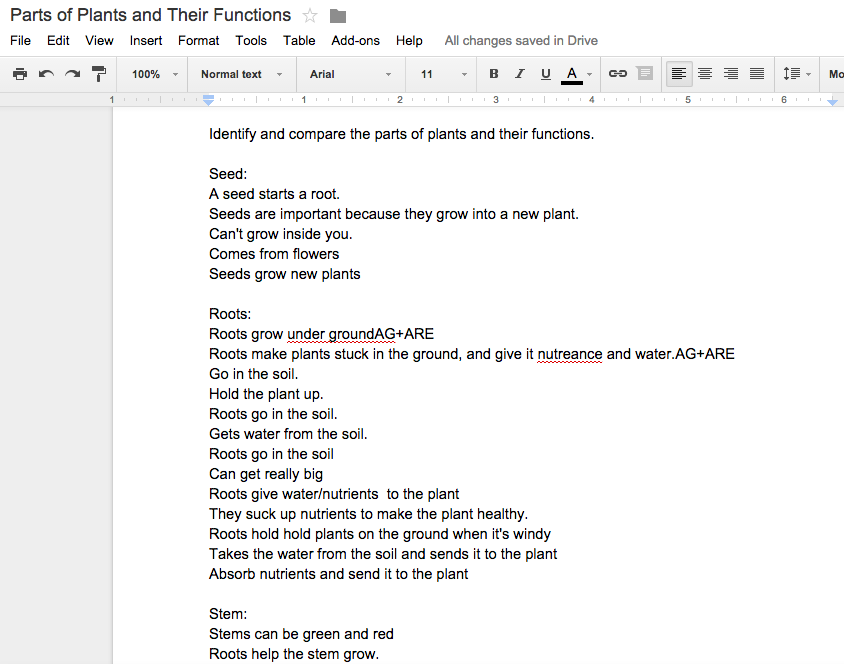
4) Research. I asked how else we could find out information about plant parts and their functions, so students decided to research in teams (more process decisions- how the students want to learn) by using various web sites and videos explaining the parts of plants and their functions. They asked if we could use a class shared Google Doc to type down notes about each plant part as they found information. Some asked if they could just take notes on post-its, and others in their science journals --> more choice in process. This is another area you can differentiate in- the process of how children learn something does not always look the same for all the students in your class. While some students may feel comfortable and ready to go and research on their own, some are not-- and this could be a time where when others are independently researching, you can pull individuals or small groups to research together or to do a mini-lesson or reteach. It is important to provide choice in this way, even for gifted students, because sometimes they aren't ready or willing to go learn on their own in various cases. Sometimes they want you to teach them something directly, and that's ok!


^ Snapshot of part of the notes on class shared Google Doc

5) Assessment/How Students Show Their Learning and Understanding: Along the way, students created different products- ways to show their learning of plants and their parts. There are so many ways students can show learning along the way of course, and you can do continual formative assessment as you work through the study. However, as a summative (in lieu of a paper/pencil test) you can often ask students how they want to show you that they've learned. Sometimes they can just orally tell you. Sometimes you can just pull them one-on-one and them show you they know. But sometimes, they want to come up with something created and original- hence, a product.

Students started their plant products at the beginning of the unit as opposed to at the end of the unit. They updated their creations and worked on them as they learned and gained new understandings. This allows the students time to actually create a sophisticated product, instead of cramming it in at the end of a study. (Note: If I were to do it again, maybe we could've made this into some sort of PBL with an audience, but I don't think it is necessarily needed here. When you incorporate inquiry and self-selected experimentation and research, it can be very real-life and real-world to younger children.) They chose their own products, from creating life-size plant models to posters to books to digital products, labeling parts and describing their functions. 

Allowing choice in product is so important for gifted learners. They often have ideas of how they could show their learning, but we can limit them by always providing the means. From the beginning of the year, I slowly teach one product at a time. I started out last year with PicCollage to make collages with text, then recorded products such as Doceri, ChatterpixKids, Shadow Puppet, or iMovie. After introducing these, students already have a good amount of choice in their products early in the year. No digital tools? No problem. Introduce other ones at first, like a poster, a foldable, or a book. You can add additional product choices to your students' tool belt as you introduce them, and by mid-year, they have a wide array of products: advertisements, poems, iMovies, collages, posters, Popplets (digital webs), brochures, dioramas, models, Important Books, comic strips, and more. You can even have a list of these with visual aides for children so that when the time arises for them to choose, they remember what they have to pick from. Product choice is also super helpful with any student. I have a twice-exceptional student who struggled with writing on paper, but when he was allowed to explore other ways to show his learning, he blossomed.


^ Examples of different products- these were from our independent study animal research projects: a triple diorama, an informational poster, and a 3D model with facts attached- student chosen, student created

I had one student create a plant model out of construction paper that was beyond any idea I had. He made a huge paper plant with a flower, leaves, a stem, and roots coming out of the bottom. The plant was in a round paper pot, where if you opened a side door on the pot, you could see the roots inside and read about them. He wrote about each of the other parts as well and attached it to the model. He was so proud of what he had done and was showing off his product to everyone in the class and talking about it with other teachers he would pass in the hallway. Boy, am I glad I didn't give him a worksheet to label...


If you are used to a 5E model when approaching inquiry- Engage, Explore, Explain, Evaluate, and Elaborate- you can find this flow in the above approach. Engage/explore often go together in generating prior knowledge and wonder wall questions and in the experimentation/hands-on activities. Explain/Evaluate occur as students are learning from their hands-on experiences and teachers are providing understanding as they go, as well as through research and study of the content along the way. Evaluation is occurring every step of the way because you started with what your kids knew or didn't know yet, monitored and gauged their learning through observation and seeing their notes and journals, and also through the products and ways they show their understanding throughout. Elaborate really goes well with the Wonder Wall questioning and experimentation-- because a lot of those questions and experiments/studies that come from them are going above and beyond the learning standard anyway.


So...who's ready to do some science right now? Because after typing all of this out, it's making those parts of my brain click wildly! I hope that this post has provided some clarity on #1 and #4 in my list. There are other examples or ways that we included the components of inquiry and of student voice and choice in the classroom, but this post is already packed full enough. Feel free to ask any questions or share ways you've done these things in the past. 

*Note #1: It is really helpful to find learning standards that go together so that you can reach all of them within one "unit." This is the approach PBL takes as well, to clump those together (cross-curricular as well!) so that you're not doing this entire process for one lone standard.

*Note #2: I also want to say that this was a year-long process for me of learning how to do these things well. At the beginning of the year I was afraid to let go of all my teacher-control, and I hadn't quite figured out how to best approach science from an inquiry standpoint. But by the end of the year, I felt that my students had helped me somewhat figure it out. Next year we will continue to work on these things and find our flow as a new class, but I am excited that we had this past year full of wondering!

Wednesday, July 1, 2015

9 Things I Wish I'd Done for GT Kids in the Regular Classroom

On April 22, 2015, I was still awake late into the night. I could not stop tossing and turning. The wheels in my mind were spinning madly as I couldn't help but think about and make a list, which I entitled, "What I would've done differently with *Mike." (*Mike's name has been changed for privacy reasons.)

You see, Mike was a child in my class last year, my 4th year of teaching in a general ed, regular first grade classroom. He was insanely off-the-charts gifted. He could do mathematical calculations on a fourth grade level using only mental math. He made the spelling bee and made it through several rounds against fourth and fifth graders. However, he was also the one you might have found hiding under the tables though or running away down the halls, pouting in a corner and refusing to get up. He was the one who was dying inside, looking for a creative or cognitive outlet, wanting to explore and go farther, deeper, higher-- and couldn't.

Truthfully, sadly, and honestly...the classroom environment that I had set up only met his needs in minimal ways. It was the best that I could do at the time. I really thought I was doing everything I could for the gifted learners in our classroom. I understood gifted children, so I tried to help them learn in the best ways possible. But when I also had children in our classroom who were at the complete opposite end of the bell curve, meeting educational needs as one human being gets very tough, tricky, and you have to make choices.

As an educator, I was always determined to not let my gifted students fall through the cracks. I never wanted to be someone that said, "Oh, they'll be fine-- they always pick up on things and I don't need to worry about them," or the person that made them be peer tutors or teach others the content all day long. Those students are not meant to be tutors or teachers when they are in the classroom. They are meant to be learners, and if the regular curriculum and content is too basic for them, we as educators are supposed to create learning experiences for them where actual growth and exploration and innovation is taking place. Not just giving them more work or sticking an upper-grade level math workbook in their face. Which, I sadly admit, was a last resort at a very low point for me last year.

When teachers are given a wide range of student abilities- cognitive, social/emotional, physical- and then expected to spin 22 plates all at the same time every day, it is near impossible to meet all the needs of your classroom. However, I made a list of 9 things that late evening on April 22nd of the things I would've done differently for Mike in the general education classroom. Things that would not have sucked me dry of time and resources. Things that would have been small fixes to big problems that needed solving. Things that would not have cost me lots of money. Things that could be made or implemented in a very little amount of time. Things I know now that I wish I would've known then. Things that could have made a big difference in his life, and allowed him to learn at the heights he was capable of.

9 Things I Wish I'd Done for GT Kids in the Regular Classroom

1) Allow student choice and voice in the classroom, specifically in giving children leadership opportunities to have ownership over the classroom and their learning- how they are to reach learning standards and goals in regards to content/process/product

2) Social/Emotional: Promoting a growth mindset + grit in our gifted students (think gifted perfectionists, gifted underachievers, gifted children who haven't been challenged before and when challenged give up quickly, and so on), as well as attending to the intellectual traits of a gifted learner (traits such as needed humility, perseverance in challenge, courage with ideas, confidence in reason, and independence in thinking)

3) Self-Assessment with a Cupcake Grading Scale to promote a gifted learner's best work at all times, not just "getting it done"

4) Using Prior Knowledge, Inquiry, Wonder Walls, Research, and Self-Led Experimentation in Science and Social Studies

5) Making Work and Learning Meaningful through Audience and PBL

6) Creativity in Content: Time to Build, Create, and Explore + Coding

7) Pre-testing + Creative Choice Menus added to the Math Curriculum

8) ELAR Fixes: Daily Five in a Must Do/Can Do format with Self Timers + Depth and Complexity added to our love of reading

9) Time for Passion Projects + Independent Study based on interest

I realized after starting to write about each of the 9 things that each of them basically needs its own post, because of how in depth they need to be explained! So, I leave you today with the short list, and I will explain each in depth over my next several posts. Also know that since I teach elementary school, my thoughts and ideas stem from that background. Some of the ideas can pertain to any grade level, but some of them are more specific to the primary grades.

Although there are so many strategies and options available for classroom teachers in regards to meeting their gifted learners' needs, a teacher is only one person in a classroom of many. There are many needs to meet, and my hope is to provide clarity and real-life, actually-tried-and-tested ways to meet the needs of your gifted learners in a regular classroom. It is hard, and differentiation is not easy, but it is worth it. They- your gifted students- are worth it. Your gifted students will thank you, and they will learn at new levels and in ways they haven't been able to before.


Monday, May 25, 2015

Asking for Feedback

So I just did something a little scary. I just sent out my first ever End of Year Parent Survey to all of my students' parents.

And I asked some hard questions. Ones that I might be afraid to read the answers to. Ones that I might have been hesitant to even include on the survey at all.

But, what I've been reading and learning is that when we are willing to ask the hard questions in order to receive quality, helpful feedback, AND when we are willing to read the responses to those questions- we are given an opportunity to grow. Learn. Change. All for the better!

I don't want to be someone who is so afraid to ask for feedback because of what might be said, that I end up not doing it at all.

Here is my End of Year Parent Survey that I just sent out. I adapted it from Pernille Ripp's parent survey that she kindly sent my way via Twitter. Feel free to use or adapt it if you would like.

The only way to grow is to make mistakes, to fail, and to learn from those mistakes and moments of failure. Perfectionism stops growth. Perfectionism says I have nothing to work on or get better at. If I am perfect, then I'm not growing. We must be willing as educators to ask for and listen to feedback, whether from parents, students, colleagues or administrators.

Next up, I will be creating a shorter Google form for my students to fill out about me. I look forward to their insight!


Friday, May 15, 2015

Where have all the school days gone?

When I lived in Russia for a summer, a friend I met there named Sasha recorded a few songs with me. He picked out the songs: Ain't No Sunshine and Where Have All the Flowers Gone? It is a sweet and fond memory of mine today. In that moment, a Russian voice and an American voice came together and made sweet harmony. That was one of many moments that made those weeks so beautiful that summer.

In light of the year winding down, Where Have All the Flowers Gone? came to mind...and made me ask, where have all the school days gone? I can't believe it is already May. Sitting in my empty classroom right now after a most exciting field day, the pit in my stomach is beginning- the pit that usually comes creeping in as the end of the school year draws close.

I always am in awe that I am given the opportunity to be a teacher. That I get to spend my days with the most precious gifts and learn with and from them. That I get to be a part of their lives. That I get to be a stepping stone on their path. That I get to know them deeply and that I get to love them. Any child I teach will forever have an impact on my life. It still is something that, when I get the quiet moments to reflect, can take my breath away. I get to be a part of lives. Lives that will one day change the world.

Where have all the school days gone
As time is passing
Where have all the school days gone
It pains me so
Where have all the school days gone
Gone to summer, every one
Hearts that I know and love
Hearts that have forever changed mine.

Friday, March 20, 2015

Short and Sweet Reflection

Days like today and weeks like this past week are ones I want to capture and remember always. This week we learned about four different types of energy- sound, heat, light, and electrical. And now...on this rainy Friday afternoon...I feel like I have been zapped of any energy that I have! :)


However, in reflection, I feel so thankful for a career where I get to laugh and grow with children who constantly make me smile. Examples from today:

This morning at our school pep rally, our principal commented on how there are only 9 weeks left of school (which, honestly, is crazy) and everyone in the gym starts cheering and hollering and I am watching my kids, thinking they will join suit. And I kid you not when I say this. Not one of them does. I watched as they sat there pretty motionless on the floor, save a few shoulder sags. And, get this- 3 or so of them actually turned around to catch my eye and gave me a sad face. What this tells me is that I have achieved one of my top goals as a teacher this year- for my children to love learning and love coming to school. For a teacher of gifted students, this is a huge undertaking, and from the reactions I witnessed today, I felt victory.


Later today I go to pick up my students from lunch and the cafeteria monitor stops me as I'm walking to pick them up. She's giggling a bit as she's talking to me, but I don't catch on until I turn around and finally see what her laughter is hinting about. Backstory: You see, my kids have started to really like to surprise me on random occasions. They are always looking for ways to catch me off guard or play harmless little surprise tricks on me. And we always just end up laughing, a lot, and I can't help but feel all warm inside of my soul because it's 1) so awesome that they feel comfortable enough with me and they care enough about the relationship we have to where they would want to have these little "inside-joke" moments together, and 2) because they clearly are thinking of ways to make me and one another laugh or smile throughout the day, which shows a lot about the growing selflessness of their hearts. We talk a lot about being selfless in here, and thinking of others- not only ourselves.


Anyway, I turn around from the monitor and see them all pretending to be asleep, every single one of them, in different positions laying their heads down and pretend-snoozing at the tables. I play along and say something to the affect of, "What's going on here?!" and they all respond "SURPRISE! We got you!" and they are all giggling and laughing and smiling and I can't help but do it, too. And we happily move along.

We love one another so much and have become such a little family in here. Our days aren't perfect, but that's what makes them good, because if you're perfect you can't GROW. And our days are packed full of growth and learning.

I am still in disbelief that I get to be their teacher.